
Introduction: Can Vibration Therapy Help Erectile Dysfunction?
Erectile dysfunction (ED) affects millions of men in the United States as well as all over the world, and its impact reaches far beyond the bedroom. When erections become consistently difficult to achieve or maintain, men often experience a mix of frustration, stress, and a search for solutions that feel both effective and safe. While prescription medications like PDE5 inhibitors remain the most common approach, not everyone can take them, not everyone responds to them, and many men are now looking for non-drug options that support sexual function in a more mechanical or neuromuscular way.
One of the newer approaches gaining attention is vibration therapy. Originally developed for neurological rehabilitation and pelvic floor therapy, vibration therapy uses targeted mechanical stimulation to activate nerves, increase local blood flow, and improve the responsiveness of the pelvic floor muscles. In other words, it focuses on the exact components involved in building and maintaining an erection. Although the idea may sound unusual at first, vibration-based therapies are not new in medicine. They have long been used to stimulate nerve pathways in spinal cord injury care, assist men recovering erectile function after prostate surgery, and help patients with reduced genital sensitivity due to diabetes or aging. The question now being asked is whether vibration therapy could play a broader role for men with mild or moderate erectile difficulties, especially as an at-home adjunct to established treatments.
This article breaks down what vibration therapy is, how it works on the nerves and vascular system, what the research really shows, and where this method fits within the wider landscape of ED management.
What Is Erectile Dysfunction and How Do Erections Normally Work?
Erectile dysfunction (ED) is defined as the persistent inability to achieve or maintain an erection firm enough for penetrative intercourse. It is one of the most common sexual health issues in men, and its frequency increases with age, diabetes, cardiovascular disease, smoking, and reduced physical activity. While occasional difficulty is normal, regularly diminished erectile quality usually indicates a physiological or neurological disruption.
To understand why vibration therapy might help, it’s useful to look at how erections develop in the first place. An erection begins with neural stimulation, i.e., signals from the brain or direct physical touch. These signals travel through autonomic nerves down to the penis, where they trigger the release of nitric oxide (NO). NO relaxes smooth muscle within the corpora cavernosa, the paired sponge-like chambers that fill with blood. As these chambers relax, arterial blood flows in more rapidly, and veins are compressed so that blood remains trapped inside. This combination creates the firmness necessary for sexual activity.
Sensory nerves also play an important role. The dorsal penile nerve, running along the top of the penis, continuously sends feedback to the spinal cord and brain. This sensory loop reinforces arousal and helps sustain the erection. When sensitivity decreases, something common with aging, diabetes, or nerve injury, the erectile response can weaken because the body receives less input to maintain arousal.
Another component often overlooked is the pelvic floor musculature. Muscles like the bulbocavernosus and ischiocavernosus contract rhythmically during arousal. They compress the penile base, limit venous outflow, and contribute to rigidity. If these muscles are weak or poorly coordinated, erections may rise but soften quickly.
ED can arise from disruptions in any of these pathways: reduced blood flow, damaged nerves, hormonal imbalance, pelvic floor dysfunction, or a combination of factors. This complexity explains why a treatment targeting only one element (for example, medication increasing NO signaling) may not be enough for every man. Approaches that simultaneously stimulate nerves, improve microcirculation, and engage pelvic muscles — such as vibration therapy — are drawing interest precisely because they address multiple components of the erectile mechanism.
What Is Vibration Therapy for Erectile Dysfunction?
Vibration therapy for erectile dysfunction refers to the use of controlled mechanical vibrations to stimulate nerves, improve circulation, and activate pelvic floor muscles involved in sexual function. Although it has only recently gained attention in men’s health, the technique itself comes from well-established areas of rehabilitation medicine, where vibration has long been used to enhance neuromuscular activity.
The devices used for ED fall into three general categories.
- The first and most targeted is penile vibratory stimulation (PVS). These are small, medical-type devices designed to deliver high-frequency vibration directly to the glans or shaft of the penis. Their primary purpose is neural: they stimulate sensory receptors and increase signaling along the dorsal penile nerve. PVS has been used for years in urologic clinics, especially for men with spinal cord injuries who need strong sensory input to trigger reflex erections or ejaculation.
- The second category includes perineal or pelvic floor vibrators, which are applied externally to the perineum, the area between the scrotum and the anus. These devices use somewhat lower frequencies, aiming to activate the underlying pelvic floor muscles. By improving muscle responsiveness, vibration may indirectly support erection rigidity and help men who experience a quick loss of firmness.
- The third option is whole-body vibration platforms, commonly found in physical therapy or fitness settings. These platforms send low-intensity vibrations through the legs and pelvis, which can increase blood flow and enhance neuromuscular activation more broadly. While not ED-specific, some clinicians consider them a useful adjunct for circulation and pelvic health.
It’s important to note that vibration therapy is not shockwave therapy (LI-ESWT), which uses acoustic waves instead of mechanical vibration; it is also distinct from electrical stimulation and from pleasure-oriented vibrators used in sexual contexts. ED-focused vibration therapy is a medical technique with targeted neuromuscular goals, not a sexual aid.
How Vibration Therapy Works on Nerves, Blood Flow, and Pelvic Floor
Vibration therapy appears simple on the surface, but its effects reach several layers of the erectile system at once. Erections rely on coordinated activity between sensory nerves, autonomic pathways, penile blood vessels, and the pelvic floor. Mechanical vibration interacts with all of these components, which is why researchers are increasingly interested in its therapeutic potential.
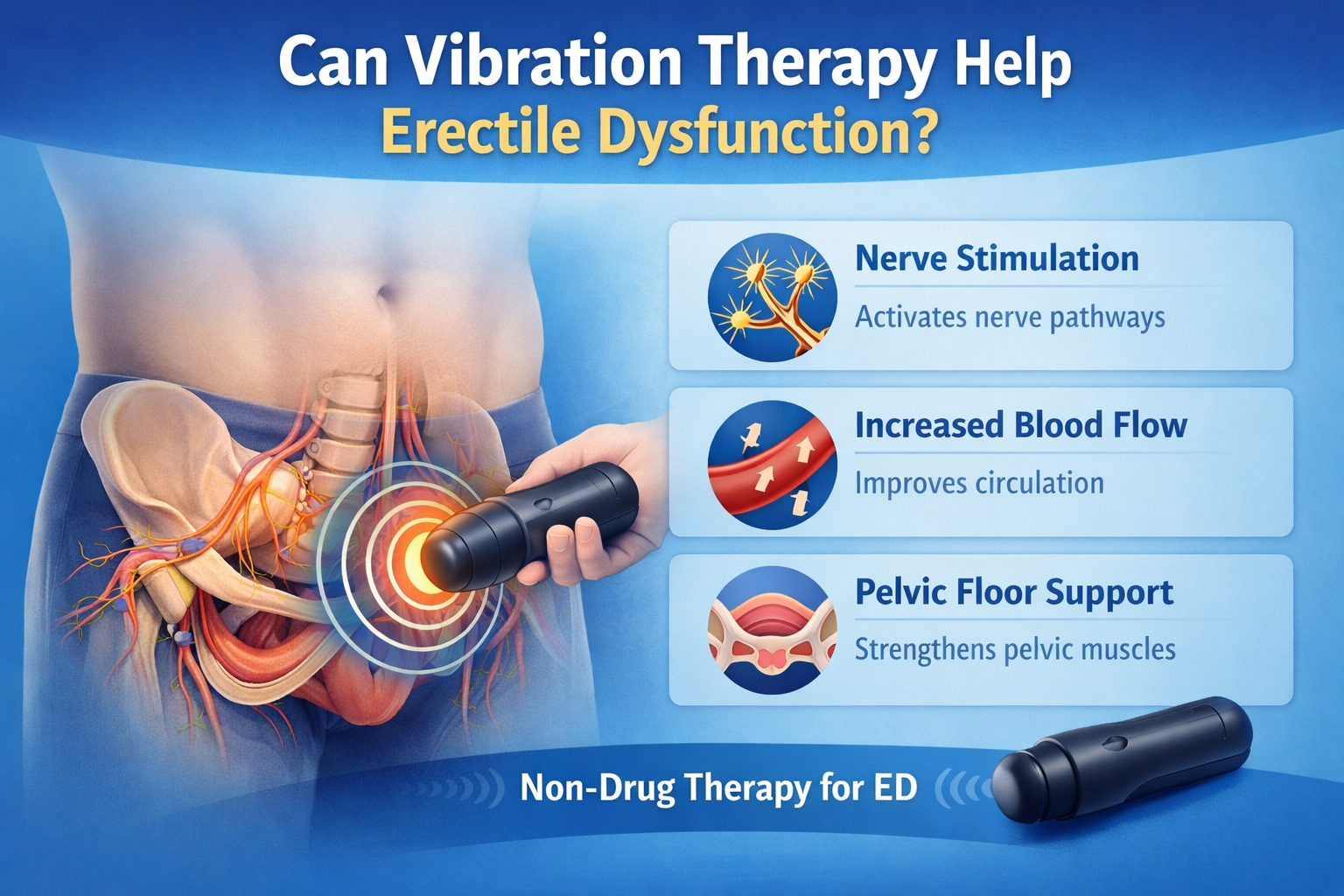 The most direct effect is neural stimulation. High-frequency vibration activates specialized receptors in the skin, particularly mechanoreceptors that respond to rapid movement. These receptors send strong signals along the dorsal penile nerve, a key sensory pathway for arousal. In men with reduced sensitivity, including those with early diabetic neuropathy or age-related sensory decline, this heightened input can improve the initiation and maintenance of arousal. In neurogenic cases, such as incomplete spinal cord injuries, vibration can even activate the sacral reflex arc responsible for reflexive erections. Alongside sensory enhancement, vibration influences blood flow and microcirculation. The rhythmic mechanical motion increases local tissue perfusion, partly through mechanical vasodilation and partly through improved endothelial function. Even short bouts of vibration have been shown in other medical contexts to increase microvascular flow. Better circulation in the pelvic region supports the processes needed for erection: arterial inflow, expansion of the corpora cavernosa, and compression of venous outflow.
Another important action lies in its effects on the pelvic floor muscles, which play a structural role in erection firmness. These muscles contract at key moments during sexual arousal, helping trap blood inside the penis. Vibration recruits muscle fibers reflexively, a mechanism similar to whole-body vibration studies where leg and core muscles activate without conscious effort. When applied to the perineum, vibration can stimulate the bulbocavernosus and ischiocavernosus muscles, enhancing their responsiveness and strength over time. For men who achieve an erection but lose rigidity quickly, this neuromuscular boost may improve firmness.
A further layer involves sensory motor integration. Erections depend not just on the presence of signals but on the brain’s ability to process them. Increased sensory input from vibration can sharpen this feedback loop, making arousal feel more immediate and reinforcing the signals that help sustain an erection. Some researchers believe this may also improve response to PDE5 inhibitors by restoring part of the neural component required for optimal drug effect.
Finally, although evidence is early, whole-body vibration may exert minor systemic effects, such as modest boosts in testosterone or improvements in vascular endothelial nitric oxide release. These changes are small but may contribute to overall sexual function, especially in men with lifestyle-related vascular insufficiency.
What Does the Research Say? (And Its Limitations)
Research on vibration therapy for erectile dysfunction is growing, but it is still in an early phase. Most current data comes from neurology, pelvic rehabilitation, and post-prostatectomy care, where vibration has been used for decades to stimulate nerves and restore function. These findings form the foundation for its expanding use in general ED management.
The strongest evidence comes from studies involving spinal cord injury (SCI). Penile vibratory stimulation has long been used to trigger reflex erections and induce ejaculation in men with certain types of SCI. These trials consistently show that high-frequency vibration can activate the sacral reflex arc and produce observable erectile responses. While this population is unique, the results demonstrate that vibration can meaningfully stimulate erectile pathways even when voluntary control is limited. There is also emerging research in post-prostatectomy rehabilitation. After prostate surgery, many men experience temporary erectile dysfunction due to nerve trauma. A few pilot studies suggest that combining vibration therapy with PDE5 inhibitors may accelerate nerve recovery and improve early erectile function compared to medication alone. These studies report improvements in penile sensitivity and better responses during sexual stimulation, though the sample sizes remain small.
Another relevant area involves diabetes and reduced penile sensitivity. Men with early diabetic neuropathy often experience diminished tactile perception, which weakens the sensory feedback needed for arousal. Small trials have found that regular vibration can improve threshold sensitivity in the glans penis and lead to modest increases in erectile function scores. While promising, these findings need replication in larger cohorts.
For men with mild-to-moderate vasculogenic ED, evidence is limited but encouraging. A handful of feasibility studies report improvements in erection hardness and subjective sexual satisfaction after several weeks of vibration therapy. Researchers believe the benefits stem from enhanced microcirculation and stronger pelvic floor activation.
Despite these positive signals, the evidence base has important limitations. Many studies involve fewer than 50 participants, and some lack control groups. Vibration parameters vary widely between trials, such as frequency, duration, and device type, making results hard to compare. Additionally, long-term outcomes are essentially unknown, as most studies last only a few weeks to a few months.
For now, vibration therapy should be viewed as a promising but still developing option, requiring further controlled research before definitive claims can be made.
What a Vibration Therapy Session Looks Like in Real Life
A typical vibration therapy session is straightforward and usually easy to follow, whether performed at home or in a clinic. Most men use a small penile vibratory device designed specifically for medical stimulation. The session begins with the penis in a relaxed, non-erect state. The device is placed against the glans or upper shaft, where sensory receptors are most concentrated. Once activated, it delivers rapid, high-frequency pulses. The sensation is distinct, not painful, not sexual, but intensely stimulating, similar to a concentrated buzzing. Many men describe a warm or tingling feeling after the first minute.
A standard session lasts about 5 to 10 minutes, sometimes up to 15 depending on the intended goal. The device may be held still or moved slightly to vary stimulation. Some users prefer shorter, repeated bursts; others use continuous vibration. The routine is flexible, but consistency is more important than the exact technique. For those targeting pelvic floor activation, a perineal vibrator is used instead. It is positioned externally, between the scrotum and anus. Gentle vibration penetrates through the soft tissues, triggering reflexive contractions of the pelvic floor muscles. This type of session feels different, more internal and muscular, and may leave the area feeling subtly fatigued, similar to a light workout.
Whole-body vibration sessions follow another pattern entirely. The user stands on a vibrating platform for 10 to 20 minutes while low-frequency waves travel upward through the legs and pelvis. These platforms aren’t ED-specific, but some clinicians view them as helpful for circulation and pelvic conditioning.
Sessions are typically performed two to four times per week. Some men notice improved sensitivity within a few weeks; others experience gradual changes over a longer period. Importantly, vibration therapy does not produce immediate “on-demand” erections. Instead, it works cumulatively, supporting the physiological processes that make erections easier to initiate and maintain over time.
Who Might Benefit – and Who Should Avoid It
Vibration therapy isn’t a universal solution, but certain groups of men appear especially likely to benefit from its mechanisms. One key group includes those with reduced penile sensitivity, whether from aging, early diabetic neuropathy, or age-related sensory decline. Because vibration increases sensory input along the dorsal penile nerve, these men may find it easier to initiate arousal and maintain erection quality. Men with mild-to-moderate ED, particularly those who still experience occasional nighttime or morning erections, may also respond well. Their erectile pathways remain partially functional, and the additional neural and circulatory stimulation provided by vibration can reinforce both arousal and pelvic floor engagement. Some urologists consider vibration therapy a useful adjunct for men who respond only partially to PDE5 inhibitors, as improved sensory signaling can enhance medication effectiveness.
Another group includes men undergoing penile rehabilitation after prostate surgery. Temporary nerve damage is common in the months following prostatectomy, and vibration therapy may help accelerate sensory recovery. Although research is early, the approach is generally considered safe when performed under medical guidance.
However, not everyone is a suitable candidate. Men with active dermatologic issues, infections, or open lesions on the penis should avoid vibration until the area has fully healed. Those with severe Peyronie’s disease, especially if accompanied by pain, may find vibration uncomfortable or potentially aggravating. Individuals with advanced uncontrolled diabetes, who have significant numbness, should be cautious as reduced sensation can mask excessive stimulation.
More broadly, men with serious cardiovascular instability or those recently recovering from major cardiac events should seek medical clearance before using any device that increases pelvic blood flow. For whole-body vibration platforms, additional contraindications include osteoporosis, recent fractures, and a history of deep vein thrombosis.
Vibration therapy is best suited to men with functional but underperforming erectile pathways, not to those with complete loss of erectile capacity. Proper screening and realistic expectations help ensure safe and effective use.
Vibration Therapy vs. Other Non-Drug ED Treatments
Men exploring vibration therapy often want to know how it compares with the non-drug options already available. While vibration shares certain goals with other treatments, it occupies its own niche somewhere between neuromuscular therapy and sensory rehabilitation.
One of the closest comparisons is pelvic floor physical therapy. Both approaches aim to improve the strength and coordination of the muscles that support erections. Pelvic floor therapy, however, is structured and exercise-based, involving targeted contractions (Kegels) guided by a specialist. Vibration therapy, by contrast, stimulates these muscles indirectly through reflex activation and enhanced sensory input. Many clinicians see the two as complementary rather than interchangeable. Another commonly used therapy is the vacuum erection device (VED). A VED creates negative pressure around the penis, mechanically drawing blood into the corpora cavernosa. It is effective at improving blood inflow but does little for nerve responsiveness or pelvic musculature. Vibration therapy is less mechanical and more physiological, supporting the body’s natural pathways rather than forcing an erection. Some men use both: VEDs for immediate rigidity and vibration for long-term neuromuscular improvement.
A very different option is low-intensity shockwave therapy (LI-ESWT). Shockwaves stimulate tissue regeneration and promote new blood vessel growth. This makes LI-ESWT a vascular treatment, whereas vibration therapy targets sensory signaling and pelvic neuromuscular activity. Shockwave therapy has more clinical data behind it but is also significantly more expensive and not widely covered by insurance.
Electrical stimulation is another comparison point. E-stim devices activate pelvic floor muscles through electrical currents. These can be highly effective for muscle strengthening but often require professional oversight and may feel uncomfortable for some men. Vibration therapy provides a gentler, more accessible alternative with fewer barriers to home use.
Finally, vibration should be viewed as an adjunct to lifestyle interventions such as exercise, weight loss, smoking cessation, and sleep optimization. Those interventions remain foundational because they affect every layer of erectile physiology. Vibration therapy fills a gap: it enhances nerve signaling, improves pelvic responsiveness, and supports overall erectile function without being invasive or pharmaceutical.
Safety, Side Effects, and Practical Tips
Vibration therapy is generally considered low-risk, especially compared to more invasive ED treatments. Most men tolerate it well, and side effects tend to be mild and temporary. Still, it’s important to understand how to use these devices safely and when to approach a clinician for guidance.
The most common side effect is temporary numbness or tingling in the penis or perineal area. This usually resolves within minutes to hours and is simply the result of overstimulated sensory receptors. Mild redness or slight irritation can also occur, especially if the device is used at high intensity or for longer than recommended. These effects are usually harmless and resolve without treatment. A smaller group of users may notice pelvic muscle fatigue, particularly after perineal sessions. This sensation is similar to a light workout and is not typically a cause for concern. Reducing session duration or spacing sessions farther apart usually solves the issue.
To minimize problems, men should start with lower frequencies and shorter sessions, then gradually increase intensity as tolerated. Keeping the device on clean, intact skin and avoiding use over painful areas is essential. It also helps to track sensations, erection quality, and any changes from week to week.
However, vibration therapy should be stopped immediately if a man experiences persistent numbness, new pain during erections, or unexpected curvature. These could indicate an underlying condition that requires a medical evaluation. Men on anticoagulants should also be cautious, as excessive pressure may increase the risk of minor bruising.
Overall, safe use comes down to moderation and awareness. When used responsibly, vibration therapy has one of the most favorable safety profiles among non-drug ED interventions.
Takeaway: Where Vibration Therapy Fits in ED Treatment
Vibration therapy offers a promising, low-risk option for men looking to improve erectile function without relying solely on medication (See, How to choose between classic and “latest” ED treatments). Its value lies in its ability to target several parts of the erectile system at once: sensory nerves, pelvic floor muscles, and local blood flow. For men with mild-to-moderate ED, reduced penile sensitivity, or early neuropathy, this multifaceted approach can reinforce natural arousal pathways and make erections easier to initiate and sustain.
That said, vibration therapy is not a stand-alone cure. It works best as part of a broader strategy that includes lifestyle improvements, medical evaluation, and (when appropriate) established treatments like PDE5 inhibitors. The current research base is encouraging but still developing, and men should approach the therapy with realistic expectations.
Used consistently and safely, vibration therapy can be a meaningful addition to an individualized ED treatment plan.
References
- Calabrò, R. S., Naro, A., Pullia, M., Porcari, B., Tomasello, P., Leonardi, S., Russo, M., Bramanti, P., & Milardi, D. (2019). Improving sexual function by using focal vibrations in men with spinal cord injury: Encouraging findings from a feasibility study. Journal of Clinical Medicine, 8(5), 658. https://doi.org/10.3390/jcm8050658 PubMed
- Segal, R. L., Tajkarimi, K., & Burnett, A. L. (2013). Viberect penile vibratory stimulation system: Evaluation of its erectogenic efficacy. Canadian Journal of Urology, 20(4), 6844–6847. https://pubmed.ncbi.nlm.nih.gov/23930610/
- Burnett, A. L., Nehra, A., Breau, R. H., Culkin, D. J., Faraday, M. M., Hakim, L. S., Heidelbaugh, J. J., Khera, M., McVary, K. T., Miner, M. M., Nelson, C. J., Sadeghi-Nejad, H., Seftel, A. D., & Shindel, A. W. (2018). Erectile dysfunction: AUA guideline. The Journal of Urology, 200(3), 633–641. https://doi.org/10.1016/j.juro.2018.05.004


